 Images & Buildings of Montréal

160 chemin Tour-de-l'Isle / Île Sainte-Hélène | Montréal
Quebec, Canada
History of the American Pavilion
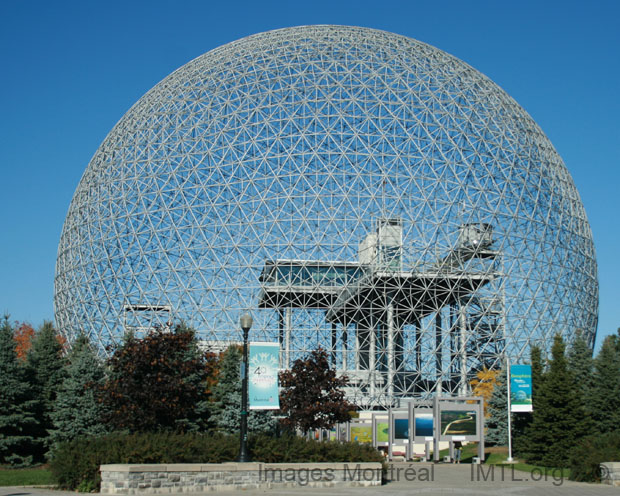
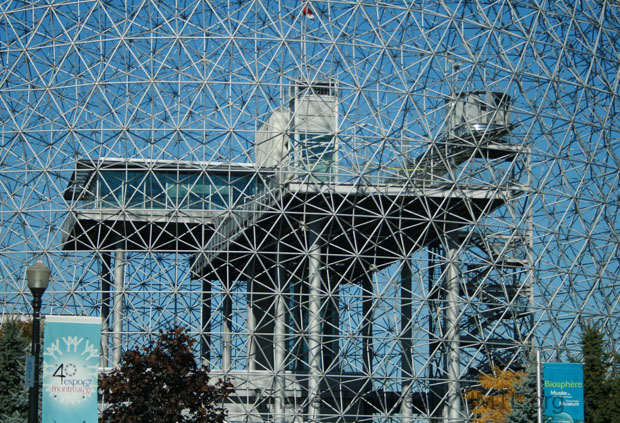
Built on the Terre des Hommes for the Universal Exhibition of 1967, the American Pavilion was intended to be one of the most spectacular of the event. Mission accomplished since the American Pavilion received more than 11 million visitors. At the time the geodesic dome was crossed by the train that crossed the exposition’s site
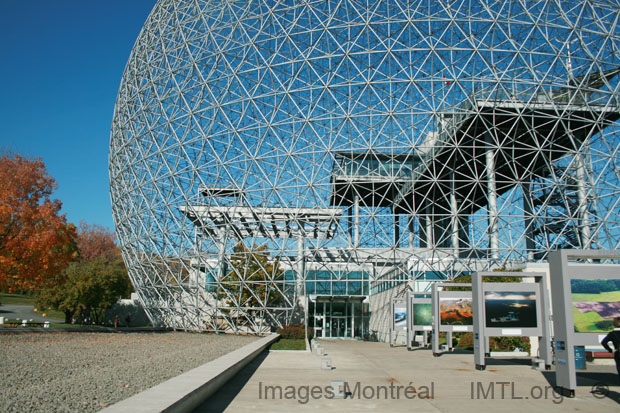
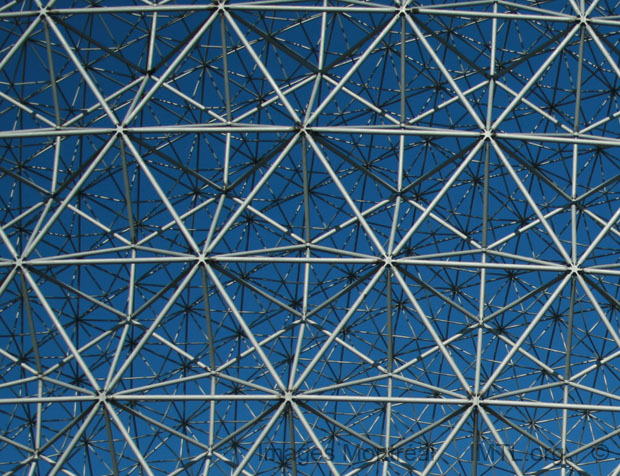
The project was designed by the inventor and architect Richard Buckminster Fuller, a real instigator and promoter of the geodesic structure dome in contemporary architecture. The renowned architect was looking for the lightest structure for a maximum volume. The height of the bubble is equivalent to a 20-storey building.
Consisting of a 3-dimensional wire mesh of triangle, the structure was covered with a set of acrylic panels, the same material that caused the loss of the original Pavilion. In 1976, a fire destroyed the outer envelope in less than an hour.
History of the Biosphere
Closed for many years after the fire by the city of Montreal, it was in 1990 that the Canadian government releases $ 17 million for the site redevelopment of the former American Pavilion. The new Environment Canada’s Biosphere finally open in 1995 after a reconstruction of the inside buildings after an architectural competition.
In 1998, new misfortune for the dome, an ice storm hit the south of Quebec Province and damage the Biosphere. The restoration lasted almost 5 months.
Prix d'architecture de l'Odre des Architectes du Québec de 1978 à 2011
OAQ, 2010
Guide de l’architecture contemporaine de Montréal
Nancy Dunton et Helen Malkin, 2008
Sur les traces du Montréal Moderne et du domaine de L’Estérel au Québec. 
France Vanlaethem, Danielle Doucet, Sophie Mankowski, Conrad Gallant, 2008
L'Architecture de Montréal
Pierre-Richard Bisson, 1990
Site Web des architectes Faucher Aubertin Brodeur Gauthier
 Expo 67
 Near subway station Jean-Drapeau
 Bus : 167
Other name
Pavillon des États-Unis, Musée de l'environnement
Get directions to this building from (zip code)
Architecture - public building
Building achieved the same year (1967)
DowntownSaint-Henri / Petite-BourgogneWestmountSaint-LaurentAhuntsic / CartiervilleCôte-Saint-LucNDGOld MontrealVerdunMontréal NordLa Petite-PatrieCôte-des-NeigesMercierPlateau Mont-RoyalRosemontVilleray / Saint-Michel Historical Milestones about Montreal, What did append the same year (1967) See History of Montreal Section
Facts about Montreal
Statistics about this page 202 page views for this month 41006 hits on this page Imtl.org has no relation with owner of this building All pictures on this website are protected through copyright. Anyone who uses them on personal or commersial websites or other media, commits a violation of the law |